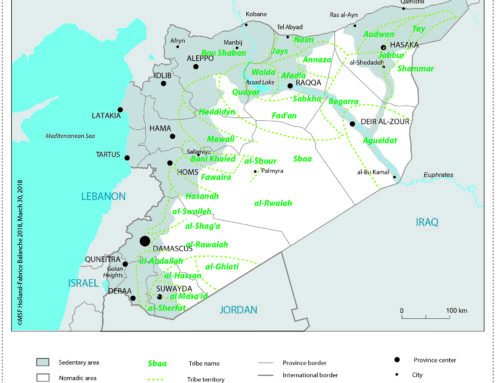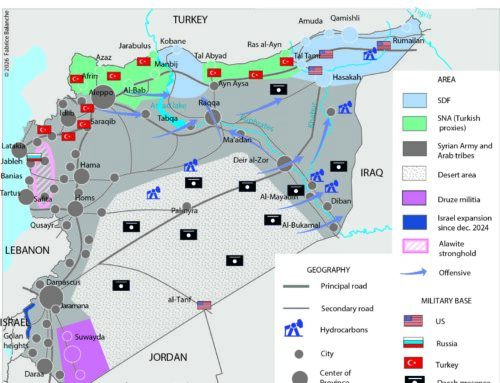

The Druze and Alawite communities are demanding the division of the country in the face of widespread bloodshed and insecurity. While Sheikh Hikmat al-Hijri advocates for a Druze state with the support of Israel, the Alawites are isolated and lack both internal structure and external backing. The Kurds are hesitant to integrate without guarantees, while the dream of unity with al-Sharaa’s regime is fading in the face of separatist demands.
Article published in Conflits on October 29, 2025
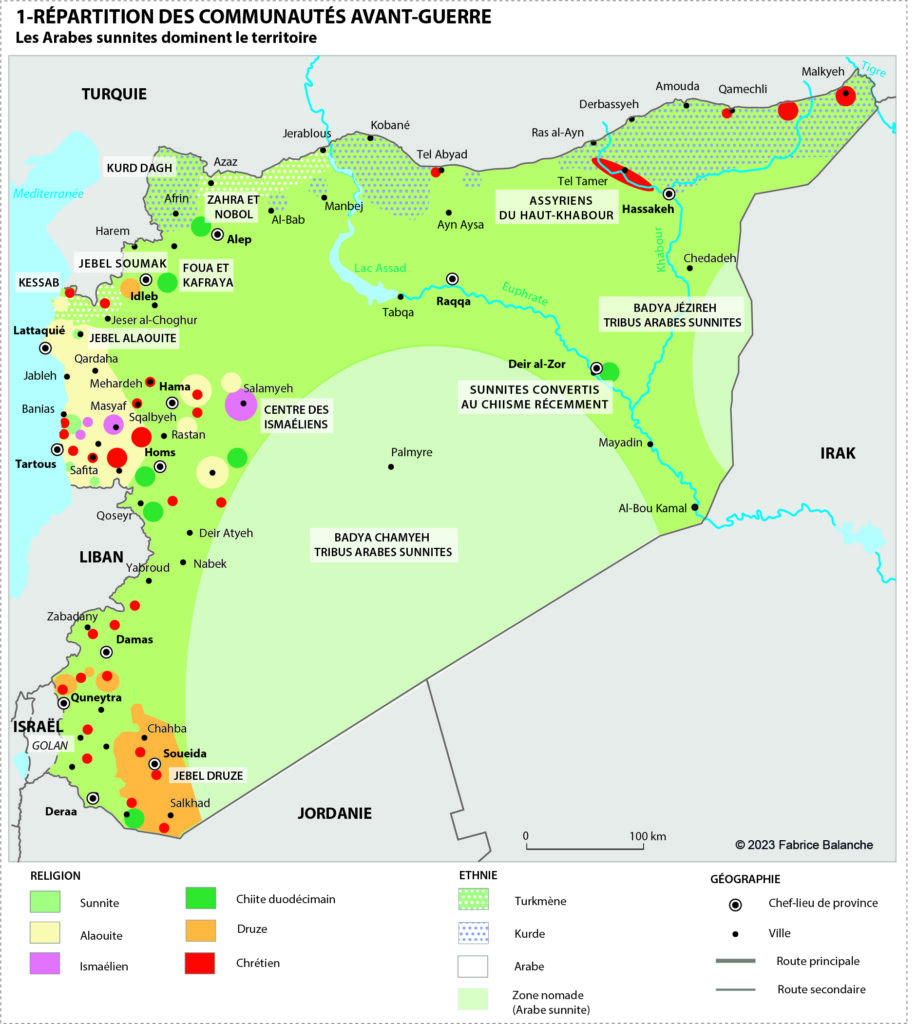
The Alawite and Druze communities, reeling from massacres and daily instability, are calling for “taqsim” (division of the country). Sheikh Hikmat al-Hijri, a prominent figure in Syrian Druze politics, is advocating for the establishment of a Druze state in their ancestral homeland. This proposal could find support in Israel, which even in the event of a peace treaty with Syria, is keen to maintain its influence in negotiations with Damascus.
The Alawite Separatism Isolation
According to Sheikh Ghazal Ghazal, who identifies as the representative of the Alawite community, they share the same desire for autonomy as the Druze. However, unlike the Druze, the Alawites lack external backing, and their political organizations are incapable of coordinating a revolt. Additionally, the population does not have faith in Assad’s officers to lead such an uprising. In March 2025, the former military officers who had formed armed groups [1] were unable to prevent the massacres. Their level of corruption was well known.
Additionally, their territory is not as cohesive as that of the Druze. The city of Latakia predominantly comprises Sunnis, as does the northern and eastern countryside. Ahmad al-Charaa can rely on the substantial Sunni communities in Jableh, Banias, and Tartus. In Syria’s interior, the Alawites are on the defensive, demographically weakened by war and vulnerable to the Sunni tide that is driving them out. The current dire situation could spark an Alawite uprising, but its outcome would be as disastrous as the one that occurred in March last year.
The SDF is a threat to the new regime.
This season, Ahmad al-Sharaa’s top priority is disbanding the Autonomous Administration of North and East Syria (AANES) [2] and integrating the northeast region. The leader of the Syrian Democratic Forces (SDF), Mazloum Abdi, signed a merger agreement [3] with the Syrian president on March 10, 2025, under the influence of the United States. However, since then, talks have stalled due to resistance from the Kurdish forces (YPG) and their Arab allies within the SDF, who are unwilling to join the new Syrian military. There is apprehension among the Druze and Alawites of experiencing the same fate. Despite assurances of integration, there has been no tangible progress. Mazloum Abdi is now requesting assurances to protect the SAA, taking cues from the Iraqi constitution, which enabled the establishment of a de facto Kurdish state through the Kurdistan Regional Government (KRG).
Clashes persist along the border between the Syrian Democratic Forces (SDF) and the Syrian security forces in Aleppo. The Kurdish neighborhood of Sheikh Maqsoud is at the heart of the confrontation, despite its isolation. The neighborhood is resisting the attempts of Ahmad al-Sharaa’s troops to overrun it. In other words, without Turkish air support, Damascus is not guaranteed a victory against the SDF in an armed conflict. It may find itself in a situation like that of the Druze, effectively ruling out the possibility of assimilating this region unless it resorts to ethnic cleansing of the Kurdish people.
Ahmad al-Sharaa wanted to reclaim the entire province of Deir ez-Zor, which holds 70% of Syria’s oil reserves, but the SDF refused to withdraw.Mazloum Abdi is not only advocating for constitutional guarantees, but is also calling for the return of Kurdish refugees expelled from Afrin, Tel Abyad and Ras al-Ain. However, these areas are currently under the control of SNA-allied militias, not the HTA.
The federal solution opposes centralization by al-Sharaa.
Turkey, with a strong desire to eradicate any Kurdish presence in the country’s northeast, is determined to stop these populations from returning to live near the border. The same holds true for the fighters who have occupied Kurdish homes and land. The situation appears to be impossible to resolve and entrenched. A federal system would be the solution, preventing armed conflict. However, this is not the political path chosen by HTA, whose centralized structure is inherent to its internal organization [8].
At present, the presence of US troops and the prospect of easing sanctions are keeping Ahmad al-Sharaa from attacking the SDF. However, he will not abandon his centralization agenda, as Turkish President Recep Tayyip Erdogan is vehemently opposed to any form of Kurdish self-governance in Syria, fearing that it could inspire similar demands from the Kurds in Turkey.
[1] The Syrian Popular Resistance of Miqdad Fatiha, a former commander of the Republican Guard.
[2] The Autonomous Administration of North and East Syria (AANES) is an autonomous political entity created in 2012 in northeastern Syria. It is led mainly by Kurds, but also includes Arabs and Assyrians.
[3] Hélène Sallon, “In Syria, a historic agreement between Damascus and Kurdish forces,” Le Monde, March 11, 2025, https://www.lemonde.fr/international/article/2025/03/11/en-syrie-un-accord-historique-entre-damas-et-les-forces-kurdes_6578805_3210.html
[4] North Press Agency, “AANES: No compromise on decentralization, SDF in army,” August 22, 2025
[5] North Press Agency, “Kurdish Neighborhoods in Aleppo Remain Under Siege Despite Cessation of Hostilities,” October 14, 2025, https://npasyria.com/en/130964/ [6] https://x.com/RojavaNetwork/status/1977136849328930895 [7] These areas have been under the control of pro-Turkish militias, namely the Syrian National Army (SNA), since March 2018 and October 2019.
[8] Drevon Jerome, From Jihad to Politics: How Syrian Jihadis Embraced Politics, Oxford University Press, July 2024
[9] Akin Ezgi, “Turkey, Syria hold high-level security summit as SDF integration talks ramp up”, Al-Monitor, October 12, 2025, https://www.al-monitor.com/originals/2025/10/turkey-syria-hold-high-level-security-summit-sdf-integration-talks-ramp