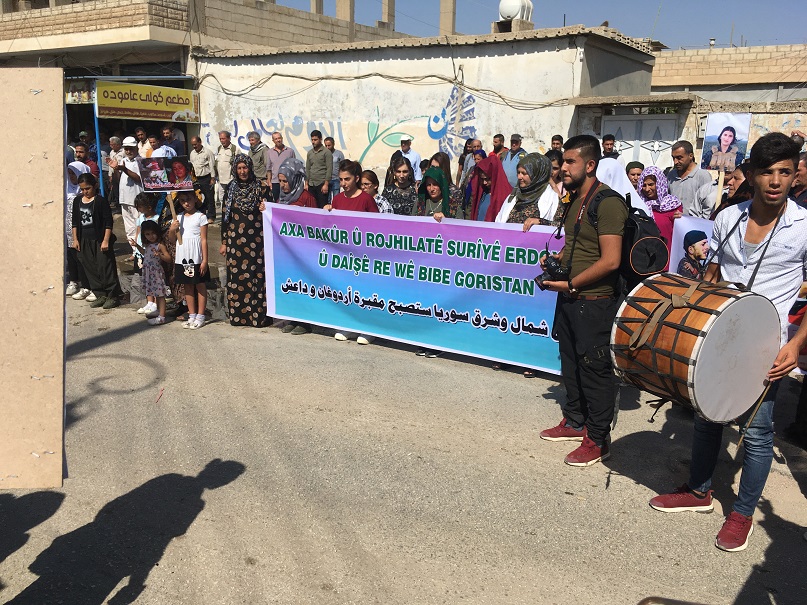
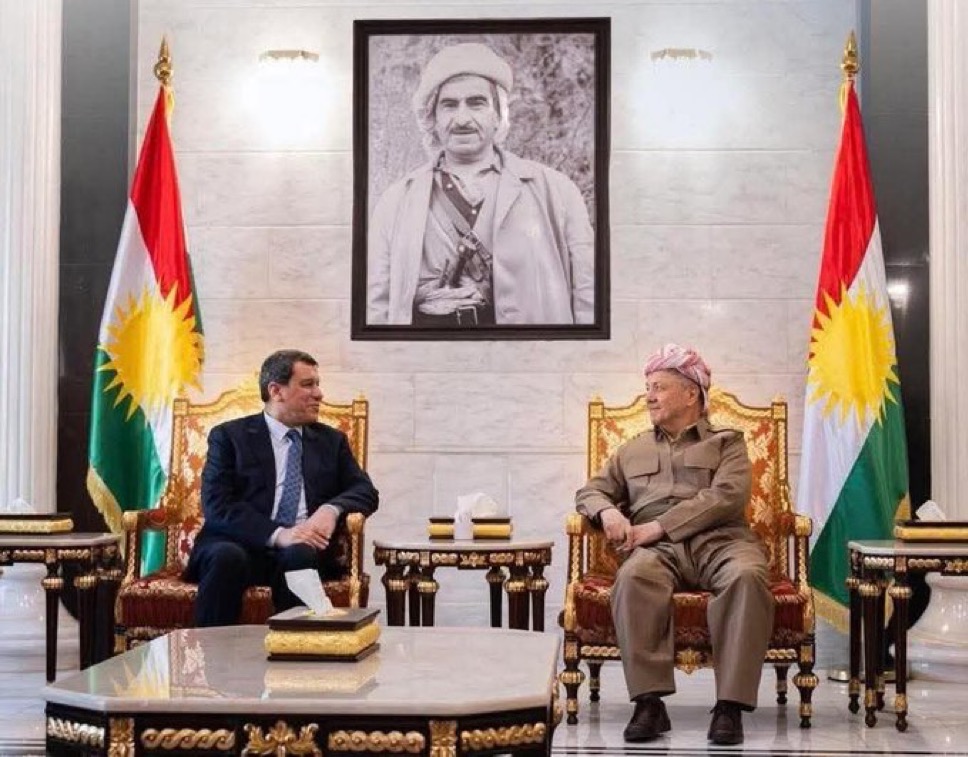
On the 10th of March 2025, Kurdish leader Mazloum Abdi and interim president Ahmed al-Sharaa met to sign an agreement incorporating the Syrian Democratic Forces (SDF) into the nation’s revamped military. The long-term plan was to integrate the territory of the Autonomous Administration of Northeast Syria (AANES). This agreement came at a crucial time for the government, whose legitimacy had been questioned in the wake of massacres in the coastal region. Six months after the beginning of the integration process, it has stalled. The SDF has only just left partially the Kurdish district of Sheikh Maksoud in Aleppo, and they have no intention of laying down their weapons. Turkey poses a threat, and Kurdish autonomy is in danger.
Article published in Middle East (in French) No. 68, October-December 2025
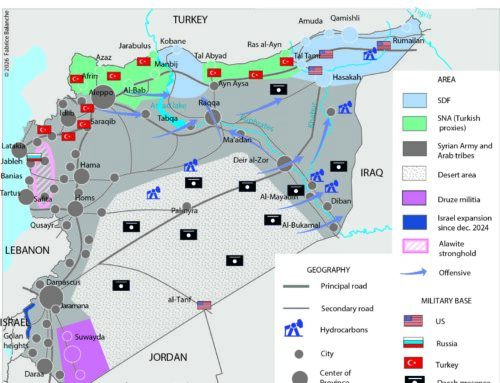
When the Assad regime collapsed in December 2024, the SDF seized control of the south bank of the Euphrates, between Maadan and Al-Bou Kamal. But their victory was fleeting, as local tribes turned hostile, and the pro-Turkish Syrian National Army (SNA) attacked Tel Rifaat and Manbij in the north. As a result, Mazloum Abdi had to deploy all his troops there. The individual in question recently vacated the recently conquered southern bank of the river, as maintaining control over the area had become too arduous. From Lake Al-Assad, they attempted to establish a pathway to Tel Rifaat, but to no avail. The Kurdish enclave was eventually overrun by the SNA. The front in Manbij crumbled on December 11, 2024, and SDF forces were forced to abandon the city and retreat east of the Euphrates. Their predicament is dire, with Ankara urging its proxies to cross the river and invade the remaining parts of the AANES. Despite this, Washington has decided to support its Kurdish ally by sending an additional 1,000 soldiers to the region, specifically near Ain al-Arab (Kobani). As his term nears its end, President Joe Biden (2021–2025) has warned Turkey that it will face consequences if it continues its attack against the Kurds.
The fragile cohesion of the AANES.
The capture of Tel Rifaat and Manbij caused around 200,000 Kurds, who had previously been displaced from Afrin, to seek refuge east of the Euphrates. They joined the multitude of people who had been forced to leave Aleppo, Ras al-Ayn, and Tel Abyad by the past. However, Ahmed al-Sharaa, who had recently conquered Aleppo during a triumphant attack in late November 2024, was not inclined to engage in a head-on confrontation with the SDF. He wanted the Syrian National Army (SNA) to play this role, giving the impression that he could peacefully reunify Syria and end internal disputes. This way, he avoided massacring the Kurds and other minorities to obtain the lifting of sanctions against Syria, his organization, and himself. The Kurds are very popular in the West, especially because they are fighting ISIS. At the same time, the SDF’s military organization is very effective, even without direct US troop support. Any attack against them would be dangerous. However, Ahmad al-Sharaa can count on some Arab populations’ sympathy for him, and their rejection of the Kurds, like in Manbij.
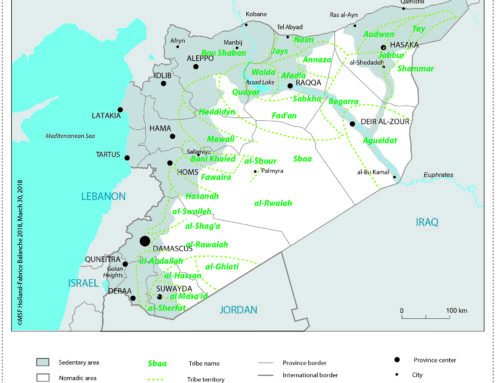
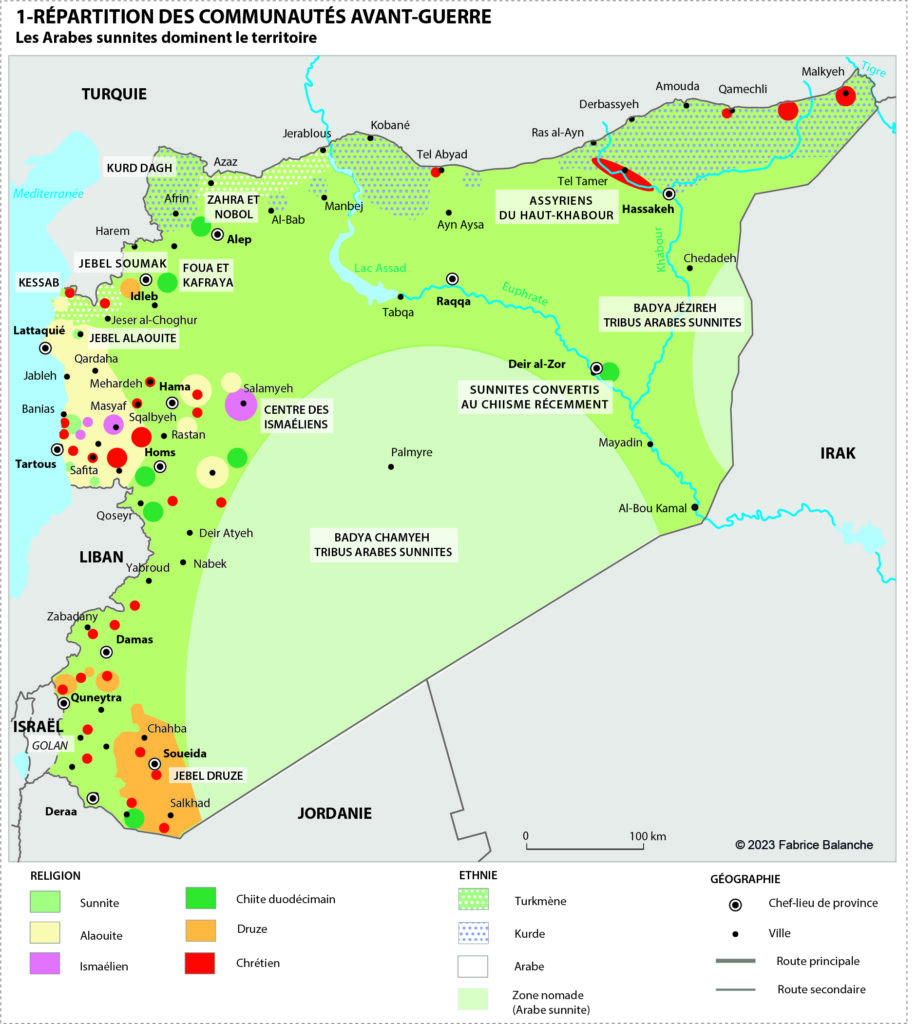
The collapse of Bashar al-Assad’s regime was met with jubilation across the AANES , but none more so than among the Sunni Arab community (60% of the local population). They would rather be under the leadership of an Islamic Arab Syria than live in an independent Kurdish-dominated region. It is worth mentioning that Arabs make up the majority of the AANES. Kurdish territories are confined to the regions of Dierik and Kobani, with the addition of Afrin until 2018, when it was taken over by Turkey, resulting in the displacement of most of the Kurdish inhabitants. The Kurdish population in the lower Euphrates Valley is largely urban, making up around 20% of the city of Raqqa’s population. In the province of Hasakah, Kurds are the majority, but they typically share the land with Arabs. This does not mean that they coexist in the same place; each community has its own village or neighborhood. In Syria, as in many other countries, the upper classes enjoy exclusive access to truly mixed spaces where wealth erases the need for sectarianism. The Arab population resented the shift in power towards the Kurds during the conflict. They submitted to their authority once they had liberated them from ISIS’s grip, thanks to the help of the international coalition. They also feared having to return to Bashar al-Assad’s regime with its conscription, repression, and predation. Western aid significantly improved the living conditions of the AANES’s population, which was about twice or thrice as high as that of Syrians under Bashar al-Assad’s rule. However, in December 2024, a surge of optimism following Ahmed al-Sharaa’s triumph sparked unified protests in Arab neighborhoods, with Raqqa at the forefront. To prevent the situation from escalating into a demonstration of hostility towards the leadership of the AANES, accused of separatism. Therefore, military deployments and arduous negotiations with Arab leaders were necessary. In March 2025, Mazloum Abdi chose to sign the integration agreement with Ahmed al-Sharaa for two main reasons: firstly, he wanted to ease tensions with the Arab community; secondly, he was seeking to buy time.
Military alliances and a game of deception.
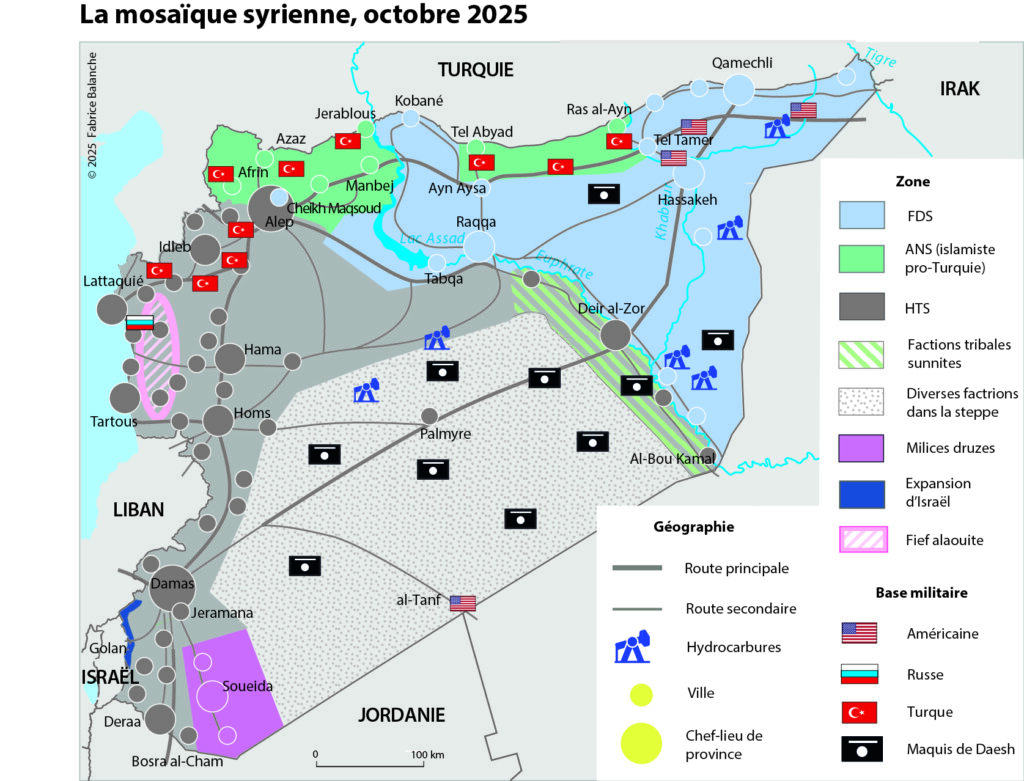
The Syrian Democratic Forces (SDF) have about 75,000 fighters, two thirds of whom are Arabs. These troops are dispersed among various tribal groups, such as the Sanadid, while the Kurds predominantly serve in the People’s Protection Units (YPG) (approximately 30,000), accounting for 75% of their numbers. The Kurdish militia forms the backbone of the SDF, as it is the largest, most disciplined, and best-equipped force. It is also the only channel for distributing American weapons. Internal cohesion in the YPG stems from strict PKK-inspired discipline, fostering the emergence of a new generation of Arab fighters free from the constraints of traditional tribal structures. The Kurdish “new man” philosophy has been exported to Arabs, albeit with varying degrees of success. The Kurdish leadership of the SDF has demonstrated the ability to navigate local tribal power structures while maintaining alignment with the PKK ideology, avoiding alienation. The SDF has remained unified despite confrontations with Turkey, the regime of Bashar al-Assad, and the Ahmed al-Sharaa regime. In the month of August 2023, Rashid Abu Khawla, the leader of the Deir ez-Zor military council, was taken into custody on charges of corruption and treason. He had gained respect as a fighter against ISIS and was entrusted with leading this complex but oil-rich region. In a matter of moments, he seized power in the local administration, redirected oil resources, and organized clandestine operations to the regime-controlled region. His goal was to establish a small “autonomous Arab kingdom,” free from the Syrian regime and the Syrian Arab Republic (SANR). His arrest sparked an uprising among his supporters in the Aguidat, his ancestral tribe, led by Sheikh Ibrahim al-Hafil. The regime of Bashar al-Assad discreetly supported him. The revolt was quelled by the Syrian Democratic Forces (SDF), aided by YPG units from Qamishli. These units supported the remaining loyal Arab militias. Concurrently, US warplanes thwarted any attempts by Shiite militias south of the Euphrates to cross the river and join Ibrahim al-Hafil’s cause. Imagine a fresh wave of Arab uprisings emerging in the city of Deir ez-Zor.
To begin with, the AANES leadership-initiated negotiations with tribal leaders to secure a larger share of the oil produced in the region. It should be noted that the Al-Omar field accounts for about 70% of Syria’s oil reserves. Smuggling with the regime-controlled area is very profitable. Secondly, the AANES sought to foster the emergence of secondary branches of the family at the expense of traditional leadership. Younger family members are believed to be more devoted to the AANES than their elderly relatives. The reestablishment of Damascus’s authority in the region would undoubtedly re-establish the long-standing order, but Kurdish leaders are aware that tribal allegiance is not unwavering, as it only serves their own purposes. The three primary drivers that keep northeastern Arab tribes allied with the Kurdish-led SDF are American support, distrust of Ahmed al-Sharaa’s success in Syria, and the material incentives on offer. The March 10, 2025, agreement is primarily a non-aggression pact rather than a desire for integration, despite the specifics of the document. Indeed, after the massacre of the Alawites, the interim Syrian president had to prove his ability to unite Syrians peacefully. After the brutal events on Syria’s coast in March 2025, doubts arose in the West about the former jihadist’s ability to guarantee a stable transition in Syria. In fact, the National Dialogue held in Damascus at the end of February was perceived as disappointing by European observers, some of whom even described it as a “monologue” because of the predominance of Ahmad al-Sharaa’s speeches. The donors’ conference held on March 17 in Brussels would have been much less successful had it not been for the agreement with AANES. The goal for Mazloum Abdi was to ease tensions among Arab communities east of the Euphrates, who demanded that Syria regain control. He also wanted to demonstrate goodwill towards the United States, which insisted on a deal with the new government. Additionally, it was crucial to mollify Turkey, which, although declaring the disbandment of the PKK in February 2025, still harboured intentions to destroy the AANES militarily if necessary. To foil any potential Turkish assassination plot, Mazloum Abdi made his way to Damascus aboard a US-owned helicopter. The Kurdish leader was hoping for a worsening of the situation in Syria, which would give him the opportunity to back out of the agreement. The massacre of the Druze people in July 2025 provided him with the ideal excuse to do so. The SDF are determined to make the Euphrates River their internal border with Damascus. They are adamant that the forces of Ahmad al-Sharaa do not set up on the left bank. Mazloum Abdi is adamant that the northern part of Deir ez-Zor province, including Syria’s largest oil field, does not come under “Syrian” control. He wants to protect its natural defenses and its revenue. For Damascus, this oil represents the most concrete and serious guarantee of the country’s reconstruction, as well as of its power. Despite the signing of over €14 billion in foreign investment contracts since the end of sanctions (date from September 2025), these are only promises, some of which seem unrealistic, such as building a metro in Damascus. The departure of US soldiers from the region, primarily focused on the Qamishli enclave, portended this shift in power. Mazloum Abdi, officially, demands that the SDF be integrated as an entity into the new Syrian army, not as individuals. He proposes that the Defense Ministry take responsibility for compensating the SDF, while allowing the latter to maintain command over its forces. Additionally, he advocates for the inclusion of a clause in the upcoming Syrian Constitution that guarantees the autonomy of the AANES. The final draft of the constitution is anticipated within the next five years. In fact, he is delaying by betting that Ahmed al-Sharaa’s regime will quickly crumble, allowing the decentralized AANES system to become a viable national alternative.
On August 8, 2025, the AANES held a congress in Hasakah. Representatives from various Syrian ethnic and religious groups attended, including Druze Sheikh Hikmat al-Hijri, leader of the resistance against the Hayat Tahrir al-Sham (HTS) trying to take over Jabal Druze, and Alawite Sheikh Ghazal Ghazal. Ilham Ahmad, who serves as the conference organizer and co-chair of the Syrian Democratic Council (SDC), the political arm of the Syrian Democratic Forces (SDF), advocated for a decentralized and secular political system in Syria. This stance is in sharp contrast to the centralized, Islamist regime that is emerging in Damascus. Ahmad al-Sharaa and Turkey strongly objected to this meeting. As a result, the planned encounter between Mazloum Abdi and the Syrian Foreign Minister on August 15 was called off. Not long after, Turkey announced its plan to offer financial and military assistance to the freshly established Syrian army. This move was perceived as a threat to the SDF, as Ankara demanded that armed groups withdraw from the Deir ez-Zor oil field and that individual fighters join the new army.
The American envoy, Tom Barrack, sought a postponement in the negotiations, acknowledging the escalating tensions in the country’s east. The positions of the AANES and the newly formed Syrian administration were diametrically opposed. The former prioritized autonomy and a secular government, while the latter aspired to establish a centralized “Islamic Republic.” The massacres of Alawites, Druze, and Christians in the west made the Kurds fear for their lives. They feared that the same thing might happen if they put down their weapons. One possible solution is the creation of a Syrian Kurdistan, based on the example of Iraq. This entity would exist thanks to a constitutional provision, an international agreement, including Turkey, and the continued presence of US troops. Its jurisdiction would be confined to areas with a predominantly Kurdish population, and not to the current regions of the AANES.
Syrian communities
What will become of the Afrin canton, under the control of pro-Turkish militias, whose Kurdish population has been largely expelled since 2018? Will the Arabs and Turkmen who have taken their place be obligated to return the homes and lands considered war booty to their original owners? We also face the same problem in Ras al-Ayn, where the Kurdish population was expelled too in October 2019. Additionally, Ras al-Ayn provided a crucial connection between Kobani and Qamishli. Creating an autonomous Kurdish region in Syria is far more complicated than creating one in Iraq. The latter has a contiguous territory except for the town of Sinjar. The Syrian Kurds have taken a more inclusive approach towards Arabs and have promoted decentralization, even within the AANES. This contrasts with the Iraqi Kurdish Regional Government. However, regardless of the territory that their political project targets, it is very unlikely to be accepted by the new Syrian regime and its Turkish allies, who, despite not launching a military offensive, continue to seek to strangle it economically.
A Suffocated Territory
Northeastern Syria is often described as the country’s wealthiest region. It contains its oil and wheat. During the Ba’athist era (1963–2024), however, this wealth did not benefit the local population. It was processed, consumed, and exported to the west. Hafez al-Assad (1930–2000) designated the provinces of Raqqa, Deir ez-Zor, and Hassakeh as producers of raw materials. The Deir ez-Zor paper mill, the Raqqa sugar refinery, and the Hassakeh spinning mill were the only industrial facilities in the region. Farmers were reduced to mere components in the machine due to the implementation of a rigid agricultural production plan. However, the regime’s construction of the Great Thawra (Revolution) Dam on the Euphrates led to improved irrigation, contributing to some prosperity in rural areas. The conflict decimated the extensive cereal cultivation infrastructure, rendering its restoration impossible due to the escalating water scarcity. Restoring cotton production would require an exorbitant investment of several billion euros in updating the outdated irrigation system. The conventional method of inundating fields is no longer tenable, leaving farmers with no other choice. The need for investment in irrigation and drip irrigation is urgent and requires a proactive approach from the state, which has the necessary resources. The ongoing drought in Syria is expected to persist for several more years, with cycles of five to seven years. This will lead to water shortages and potential local conflicts. Turkey’s water retention methods, such as the use of dams and pumping groundwater from upstream, exacerbate the water shortage.
Since Ankara gained control of Ras al-Ayn, its main water source, in October 2019, the city of Hassakeh has been without a consistent water supply. Residents have had to rely on water trucks, while the poorest have had to drink brackish well water. NGOs have helped provide drinking water, but this is not enough, nor is it sustainable in the long term. Building a new water pipeline that draws from the Tigris River, which is 200 kilometers away, would be more favorable, at an estimated cost of €2 billion. Before initiating this project, the current distribution network must undergo extensive renovation, which will require a substantial financial commitment of hundreds of millions euros. The water scarcity issue in this city is not unique; it is a common problem affecting all urban areas in northeastern Syria. Remarkably, severely damaged cities like Kobani have been successfully rebuilt in a matter of years through private investment from the Kurdish diaspora. Despite the dire condition of water and sewage infrastructure, residents are forced to depend on tanker trucks to fill their cisterns. International aid is restricted to emergency relief, rather than reconstruction. To facilitate reconstruction, an international gathering and the endorsement of Damascus are essential. The AANES lacks international recognition, with the exception of Catalonia, regardless of whether Bashar al-Assad or Ahmad al-Sharaa is in power.
The Syrian Ministry of Information has issued a caution to journalists and non-governmental organizations (NGOs) planning to travel to the Syrian Kurdistan region. They are advised to enter through Damascus rather than the informal Fesh Khabour crossing between Syrian and Iraqi Kurdistan. Failure to do so will result in denied entry into Syria. NGOs are also urged to obtain accreditation from the new authorities in Erbil before operating within the AANES territory. Ahmad al-Sharaa’s regime is following in the footsteps of Bashar al-Assad, but with the advantage of backing from NGO funders. This makes it more difficult for them to continue their activities in the northeast, where they contributed to the local economy.
A Future Dependent on Regional Geopolitics
The future of the ANNES remains uncertain considering concentrated power. Ahmad al-Sharaa and his main allies, Turkey and Saudi Arabia, are opposed to the idea of a federal Syria. The Kurds can only count on the support of the Europeans, particularly France. The American political landscape is divided between indifference towards Syria and support for an ally who has played a key role in the fight against ISIS. Israel advocates for a federal solution in Syria and rejects Ahmad al-Sharaa’s political project. Additionally, it supports the United States continued backing of the Kurds, like the Druze. Additionally, in its conflict with Iran, the Kurds are a potent internal counterweight.
The issue of northeastern Syria goes beyond the conflict between centralization and federalism, or the clash between the Sunni Arab majority and minority groups. It must also be understood in the context of the struggle between Israel, the Islamic Republic, and Turkey in this geopolitical buffer zone, which includes Lebanon, Iraq, and Syria.
Fabrice Balanche