By Fabrice Balanche, published in Conflits, 17 January 2026.
Important update
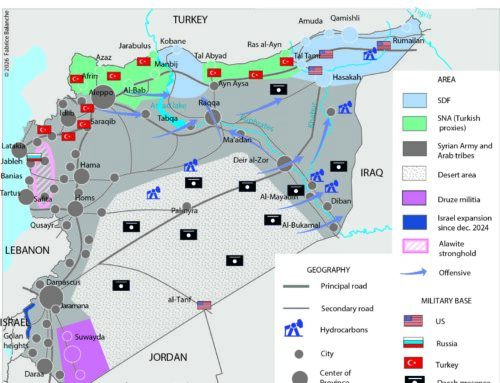
This article was published on Saturday, January 17. The Syrian Democratic Forces (SDF) had reached an agreement with the Syrian army thanks to American mediation. The SDF agreed to vacate the Tel Hafar area, situated to the east of the Euphrates. Nevertheless, Ahmad al-Sharaa’s troops broke their promise, capturing the town of Tabqa, located south of the Thaoura Dam, and posing a threat to cross the Euphrates. South of Raqqa, it conquered the villages around Mansoura, which were supposed to remain under SDF control. It is now trying to cross the Euphrates to enter Raqqa.
Meanwhile, in Deir ez-Zor, al-Sharaa’s troops, backed by local tribes, have taken over Conoco, a town situated north of the river. They are now aiming to seize the al-Omar oil fields. Several northern Euphrates villages are now under the control of Arab clans hostiles towards the SDF. Ahmad al-Sharaa has made it clear that he intends to retake the entire Euphrates Valley, Raqqa, Deir ez-Zor, and the al-Omar oil fields by force.
The March 10, 2025, agreement on the integration of the SDF into the Syrian army is now void. Plans are in place for a massive clash in the northeast between, YPG, the Kurdish militia, and al-Sharaa’s army, bolstered by local Arab tribes. The United States threatened al-Sharaa with the reinstatement of sanctions. However, its air force did not enforce the January 16 agreement. As a result, al-Sharaa retains the ability to annihilate the AANES.
The end of the Kurdish entity in Syria?
Recognizing Kurds as Syrian citizens is a superficial gesture aimed at appeasing the West regarding their status in the emerging Syrian state. The possibility of ethnic cleansing and expulsion from Syrian soil remains a serious concern.
A cosmetic recognition
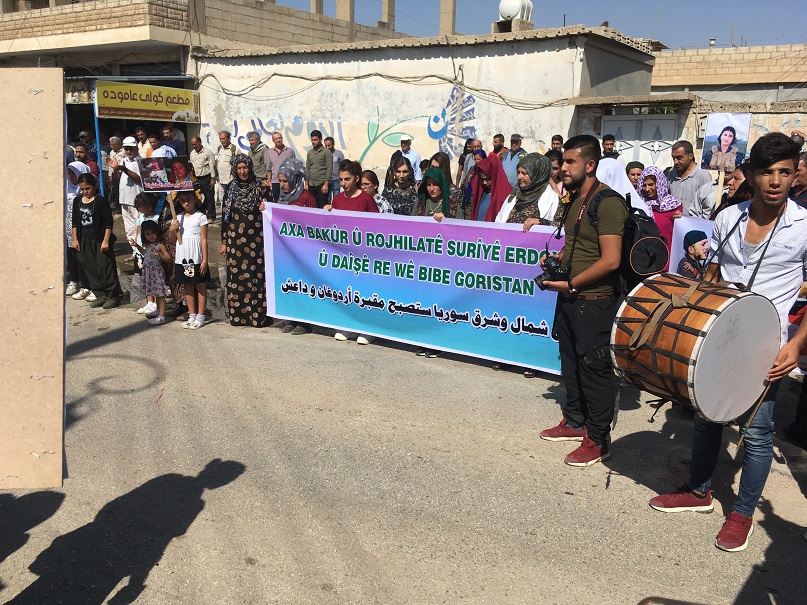
On January 16th, Syrian President Ahmad al-Sharaa officially recognized the Kurds as full Syrian citizens, granting them the right to speak their language and celebrating Nawruz (March 21st) as a national holiday in Syria. This declaration was made in the aftermath of the bloody fighting in Aleppo’s Kurdish district, which led to an estimated 150,000 people fleeing to the northeast, a region that remains under the control of the Kurdish-led Syrian Democratic Forces. It appears that Vice President James Vance of the United States expressed strong dissatisfaction with the American government, threatening to reintroduce the Caesar Act. This may explain why Ahmad al-Sharaa quickly recognized Kurdish rights in Syria. In the days before his official visit to Germany, he had to make a gesture of appeasement. The recognition of the Kurds as Syrian citizens is merely a cosmetic measure intended to reassure the West about their fate in the new Syria.
The agreement of March 10, 2025, between Mazloum Abdi, leader of the SDF, and Ahmad al-Sharaa regarding the integration of the SDF came after the massacre of the Alawites. It was crucial to demonstrate to the United States and the European Union that the new Syrian regime could unify Syria peacefully. A week before the annual Syria conference in Brussels on March 17, 2025, it was also essential to create a favourable impression. This did not prevent the subsequent massacre of the Druze in July, the continued repression against the Alawites, and now the attack on Sheikh Maqsoud and the SDF today.
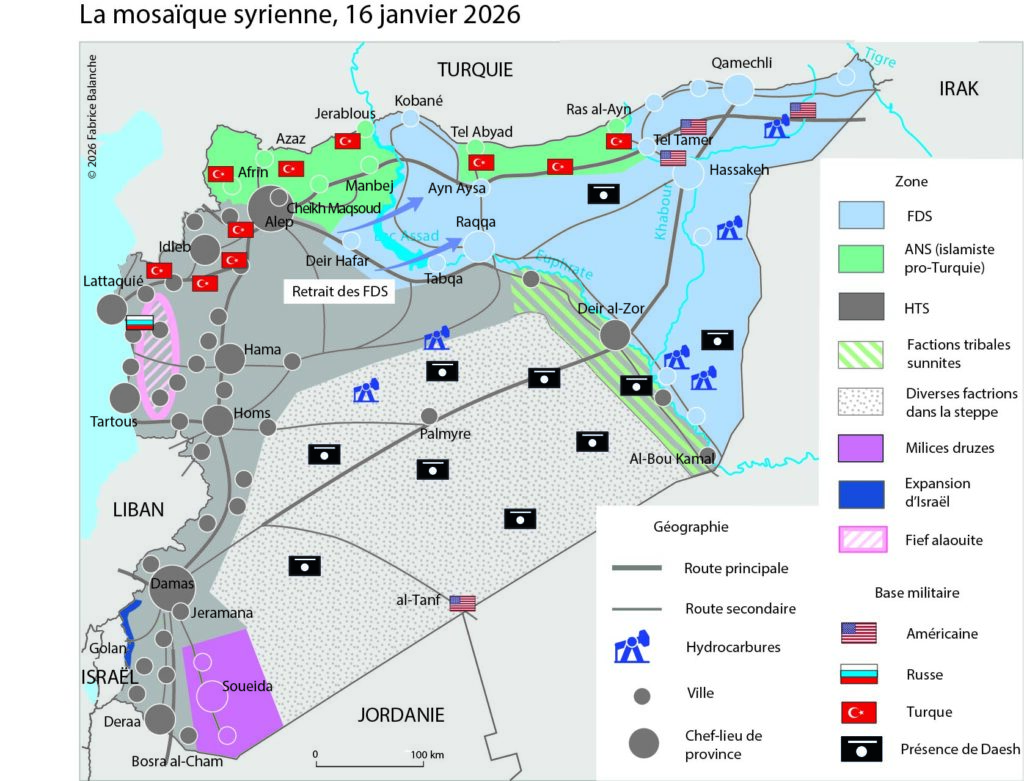
La mosaique syrienne 15 janvier 2026
Destruction of the AANES
The new Syrian regime is working to dismantle the Autonomous Administration of North and East Syria (AANES) and the SDF. No local autonomy will be tolerated. Since March 2025, Damascus has been skilfully manoeuvring to sabotage negotiations with the Kurds, ultimately blaming them for hindering the nation’s reunification. The SDF’s withdrawal from the eastern side of the Euphrates, after the evacuation of Deir al-Hafar, a town on the western shore of Lake Assad, is just one step. Tomorrow, Ahmad al-Sharaa will demand that the SDF leave Raqqa, Deir al-Zor, and the entire Euphrates Valley. Al-Sharaa’s main priority is Deir al-Zor, as it contains a significant portion of Syria’s oil reserves. By encouraging foreign companies to return to the area, he aims to generate revenue for his regime.
Raqqa serves as the official seat of power for the AANES, solidifying its identity as an Arab-Kurdish federation. The city’s inhabitants are predominantly Arab, while the Euphrates Valley, stretching from Lake Assad to the Iraqi border, is entirely Arab. Kurdish military forces remain active in the area, ensuring their presence through generous autonomy granted to nearby Arab clans. This approach aims to prevent conflict. However, these tribes long for an Arab-led government, particularly in the wake of Bashar al-Assad’s downfall.
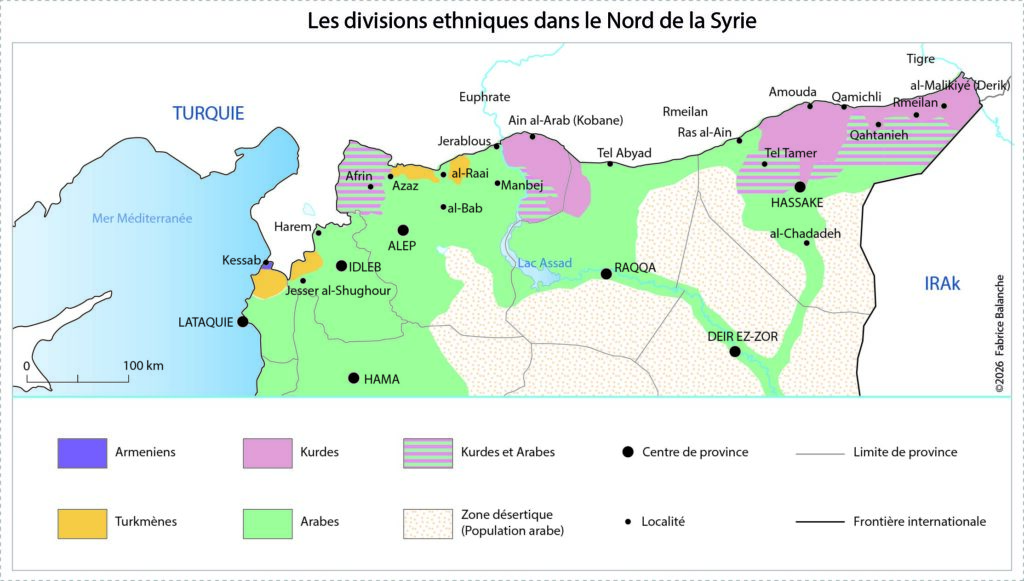
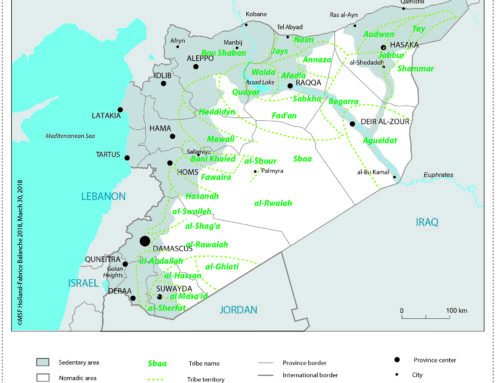
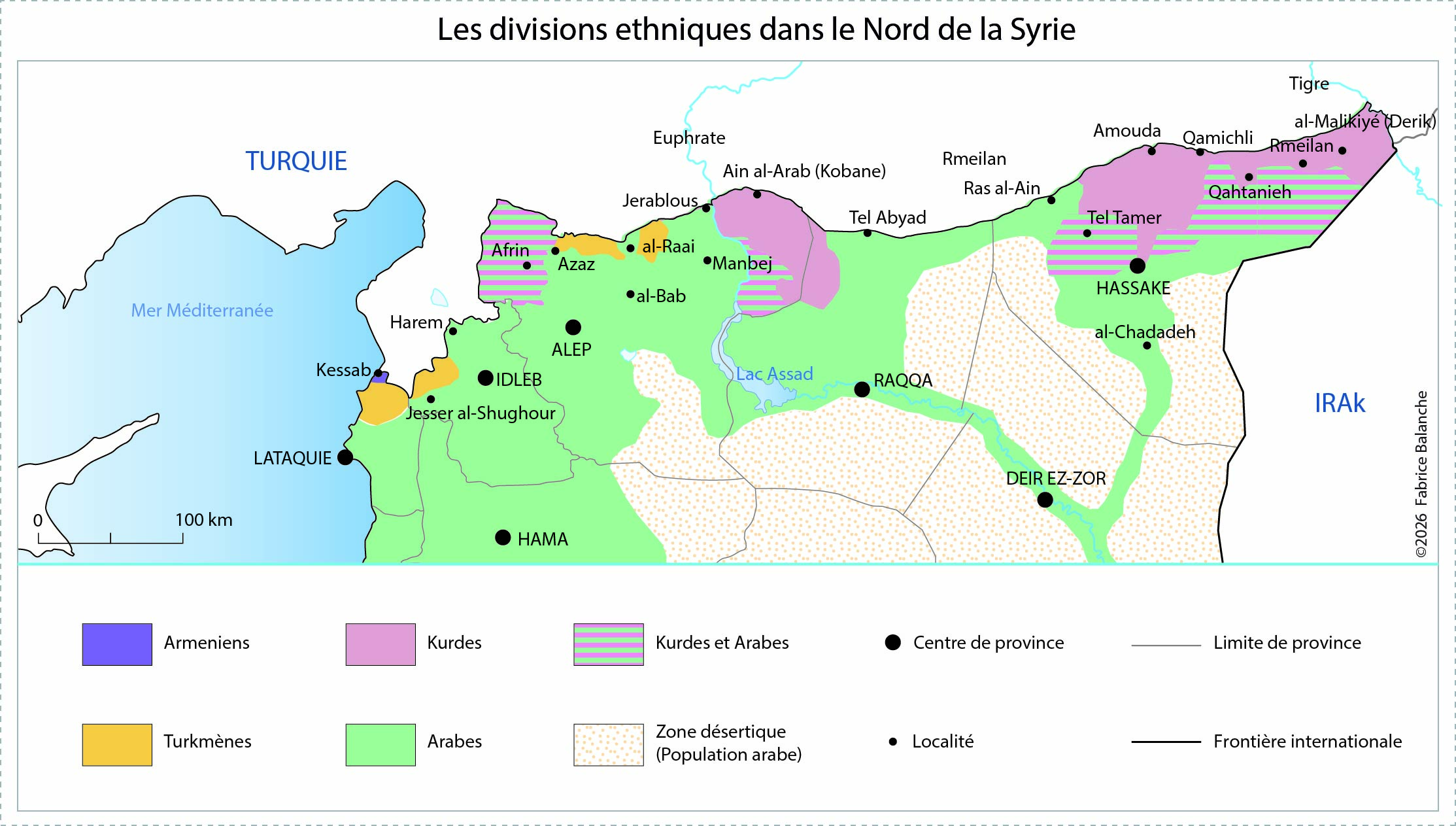
Divisions ethniques dans le nord de la Syrie
Kobani, Hasakah, and Qamishli could fall too
Kobani, which symbolizes Kurdish resistance against the Islamic State, is surrounded by Turkey in the north, by territories under Turkish military control to the east (Tel Abyad) and west (Jerablus), and by a hostile Arab campaign to the south. The imposition of a siege like that of Afrin in 2018 will inevitably lead to the city’s fall, and the departure of most of its Kurdish population. The same thing happened in Afrin, where Arab militias now rule, having seized Kurdish property.
In Hasakah, a city of 500,000 inhabitants, the population is predominantly Arab and deeply hostile toward the Kurds. The city has faced a drinking water shortage since the Turkish invasion of Ras al-Aïn in October 2019. This stressful situation has led to a deterioration of social bonds and an increase in Arab resentment towards the Kurds, who are perceived as responsible for the Turkish-led blockade.
However, there is still the region of Qamishli and the “duck’s beak,” where Kurds form the majority. But even there, local Arab tribes harbour animosity towards them, and Turkey is not far away. However, the Kurds could find a final refuge in this place thanks to the presence of American bases. Provided, however, that the United States does not withdraw its troops. However, it’s essential to maintain Western monitoring considering the ongoing detention of thousands of ex-ISIS fighters in the area. It is difficult to imagine that the Islamist militias of al-Sharaa are as effective.
The West Wants Only to Avoid the Massacre of the Kurds
The dismantling of the SDF has begun. The West has abandoned the Kurds, who were so loyal and effective during the war against the Islamic State. Nevertheless, SDF are determined to stop al-Sharaa’s troops from invading the northeast region, as history has taught us that the newly formed Syrian army is unlikely to show any mercy towards the Alawites and Druze.
For al-Sharaa, eliminating the AANES has become a priority. It is the best way to unite the Arab population behind him, given the pervasive racism against Kurds in Syria. After the fall of Sheikh Maqsoud, the celebrations in Aleppo were unfortunately sincere. As for his fighters, they enjoy crushing American allies and looting their homes. No strategy is as potent as defeating the Kurdish rebels to create a new Syrian military and avenge the humiliation inflicted by the Druze and Israel in July 2025.