
- On November 24, Iraqi Prime Minister Ali al-Zaïdi ordered the Kurdistan Regional Government (KRG) to hand over control of oil fields in the “disputed territories” and of border crossings.
- Behind the rhetoric of national unity lies a Tehran-backed power grab aimed at dismantling Kurdish autonomy altogether, while Washington looks on with indifference.
Article by Fabrice Balanche published in Revue Conflits (in French) on November 25, 2026
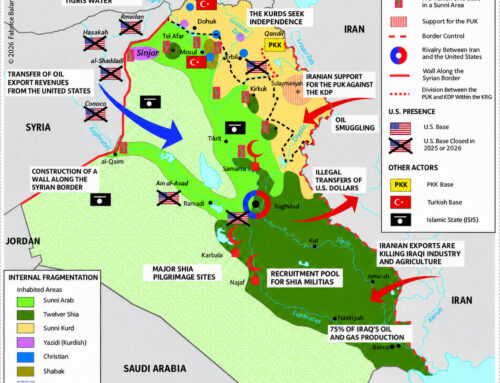
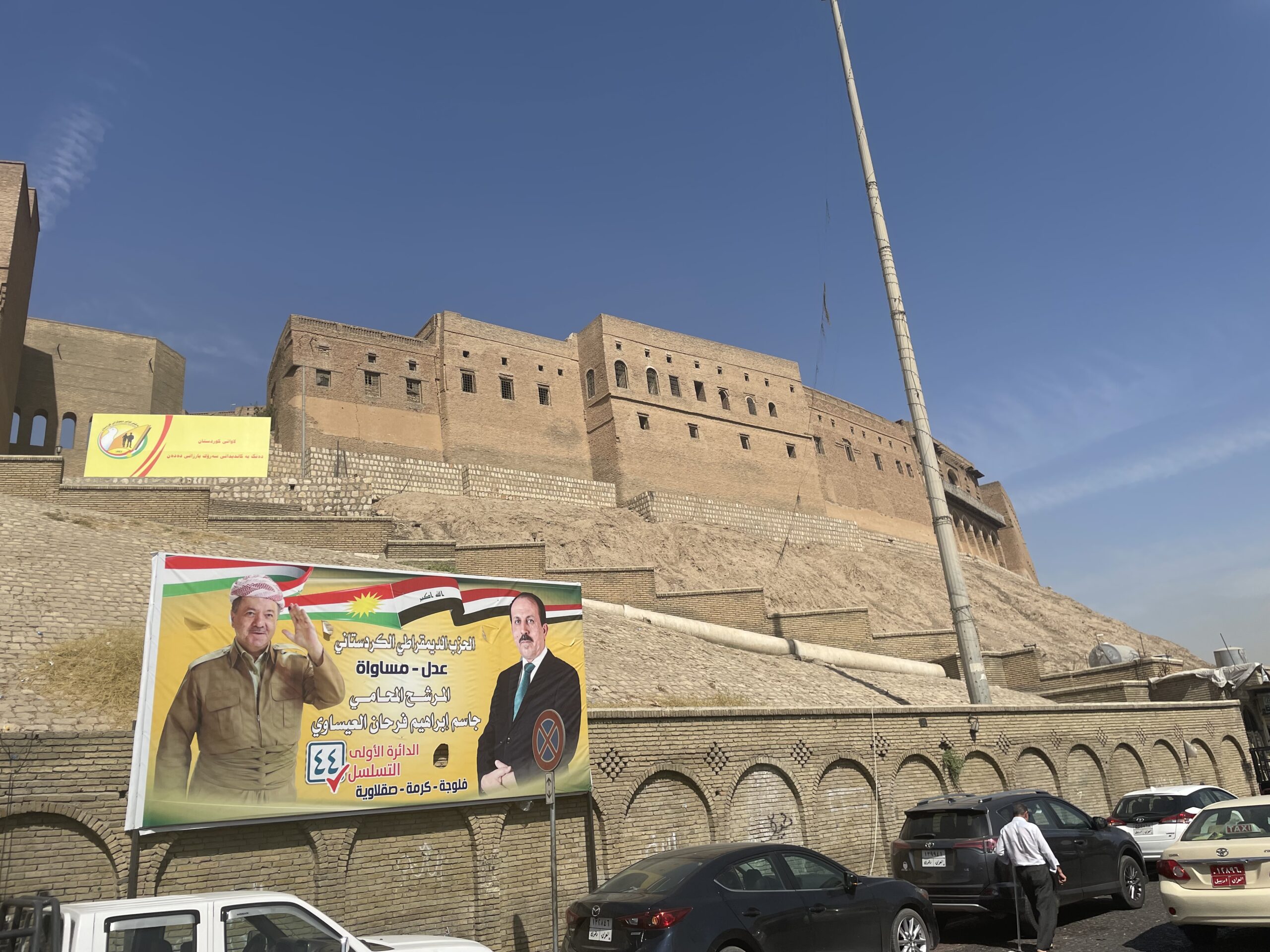
On Tuesday, November 24, Iraqi Prime Minister Ali al-Zaïdi ordered the Kurdistan Regional Government (KRG) to hand over control of oil fields in the “disputed territories”1 and of international border crossings2. The demand is intended to deprive the KRG of vital economic resources that underpin its autonomy, since the central government has refused to pay it the full allocation guaranteed by the constitution since 2014. These economic difficulties have persisted ever since. Even so, anyone who visits the region can see that the Kurdish authorities have managed to develop it far beyond expectations since Saddam Hussein’s fall. Erbil, the capital of Kurdistan, stands out clearly from Baghdad for its modernity and dynamism, to say nothing of security.
Fabrice Balanche, Grandeur et misère de l’axe iranien : Liban, Syrie et Irak, (Greatness and Misery of the Iranian Axis: Lebanon, Syria, and Iraq), Odile Jacob, 2027
A Goal Shared in Baghdad and Encouraged by Tehran
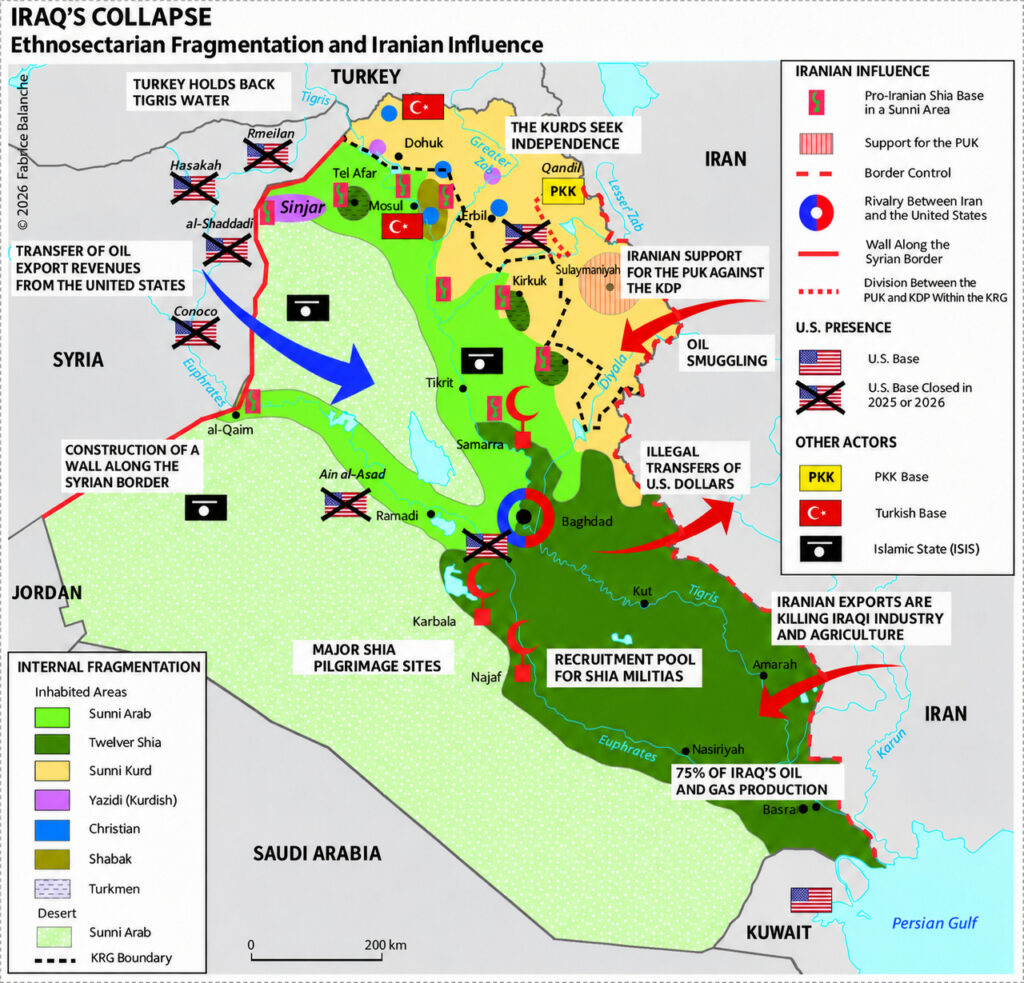
Baghdad’s decision is only the first step toward taking control of all the region’s oil resources and then dissolving the KRG. In Iraq, Shia and Sunni Arabs from different political and tribal factions agree on this goal. Unfortunately, the growing rift between the KRG’s two longstanding parties, the Kurdistan Democratic Party (KDP) and the Patriotic Union of Kurdistan (PUK), also helps advance it. The two parties failed to form a government after the 2024 regional elections.
Finally, Ali al-Zaïdi has received the blessing of Tehran, which fears that Iraqi Kurdistan could serve as a base for an uprising in Iranian Kurdistan. Iraq’s determination to dismantle the KRG must be seen in the context of the conflict between the United States and Iran. It is surprising that Washington has yet to respond to this development.
In the Shadow of the US–Iran Confrontation
Then there is the Iraqi army’s November 20 operation against a stronghold of the pro-Iranian Shia militia Kataeb Hezbollah in Jurf el-Sakhr, north of Baghdad. One might naively assume that the demands placed on the Kurds are part of a broader effort to restore the central government’s authority throughout the country. This appears to be the prevailing view in Washington, as US special envoy Tom Barrack has said he wants a strong Iraqi state.
It is essential, however, to understand that Ali al-Zaïdi is under pressure from Tehran. Should it not be obvious to the White House that the Iraqi army is as powerless against pro-Iranian militias as the Lebanese army is against Hezbollah? The anti-corruption campaign in Jurf el-Sakhr did recover $1.7 million, and $780 million has been recovered across Iraq over the past year3, but this is only a drop in the bucket in a thoroughly corrupt country and regime.
Ali al-Zaïdi, like Mohamed Shia al-Soudani before him, was jointly appointed to lead Iraq by Tehran and Washington. Al-Zaïdi’s predecessor began his term with an anti-corruption campaign targeting the previous prime minister, Moustafa al-Kazimi, and his team. Among other things, this forced all foreign and Iraqi companies that had signed contracts under the previous administration to renegotiate their terms, effectively renegotiating how they shared profits with those in power. Ali al-Zaïdi’s decision goes beyond a mere power grab under the guise of clean government. He seeks to eliminate the KRG’s autonomy and extract as much benefit as possible for the Islamic Republic.
The Last Pro-Western Stronghold
In the spring of 2026, Kurdistan, particularly Erbil, was hit hard by missiles and drones launched by Iran and by pro-Iranian Shia militias. Tehran made it clear that it would completely destroy Kurdistan if the region served as a base for an attack on Iran. Erbil therefore took a cautious approach and stayed out of the conflict, especially since the United States offered it no protection. Even so, this did not placate Tehran, which now has a chance to do away with Iraq’s last pro-Western stronghold following the departure of US and French forces in September 2026. This withdrawal sent an encouraging signal to our adversaries in the Middle East, especially amid the current conflict with Iran.
Federalism as the Only Safeguard Against Dictatorship
The presence of Western military forces was essential to keeping pro-Iranian factions from attacking Iraqi Kurdistan. Baghdad’s rhetoric about national unity is a pretext to persuade Europeans and Americans that Iraq’s territorial integrity is essential to the stability of the country and the region. Western countries struggle to grasp that centralization in multicultural states inevitably allows one group to dominate the rest of the population, and the most authoritarian elements within that group to take control. In Iraq, pro-Iranian Shia groups hold power, while liberals are marginalized.
Democracy can take root only in a federal system. With a territory of their own to give them a sense of security, the various communities would be more willing to accept a common political framework free of the nationalist claims that invariably lead to ethnic cleansing and dictatorship4.
Notes
- Iraq’s “disputed territories” are an area of about 45,000 km² south of the autonomous Kurdistan Region. Both the federal government in Baghdad and the Kurdistan Regional Government (KRG) claim the area. Baghdad has consistently refused to hold the referendum provided for in the 2005 constitution to determine the territories’ status. ↑
- RFI, “Iraq: Prime Minister orders takeover of border crossings in Kurdistan,” November 25, 2026. ↑
- RFI, “Iraq: Anti-corruption operation in Jurf al-Sakhr, a Kataeb Hezbollah stronghold,” November 23, 2026. ↑
- Fabrice Balanche, Grandeur et misère de l’axe iranien : Liban, Syrie et Irak,( Greatness and Misery of the Iranian Axis: Lebanon, Syria, and Iraq) Odile Jacob, 2027. ↑